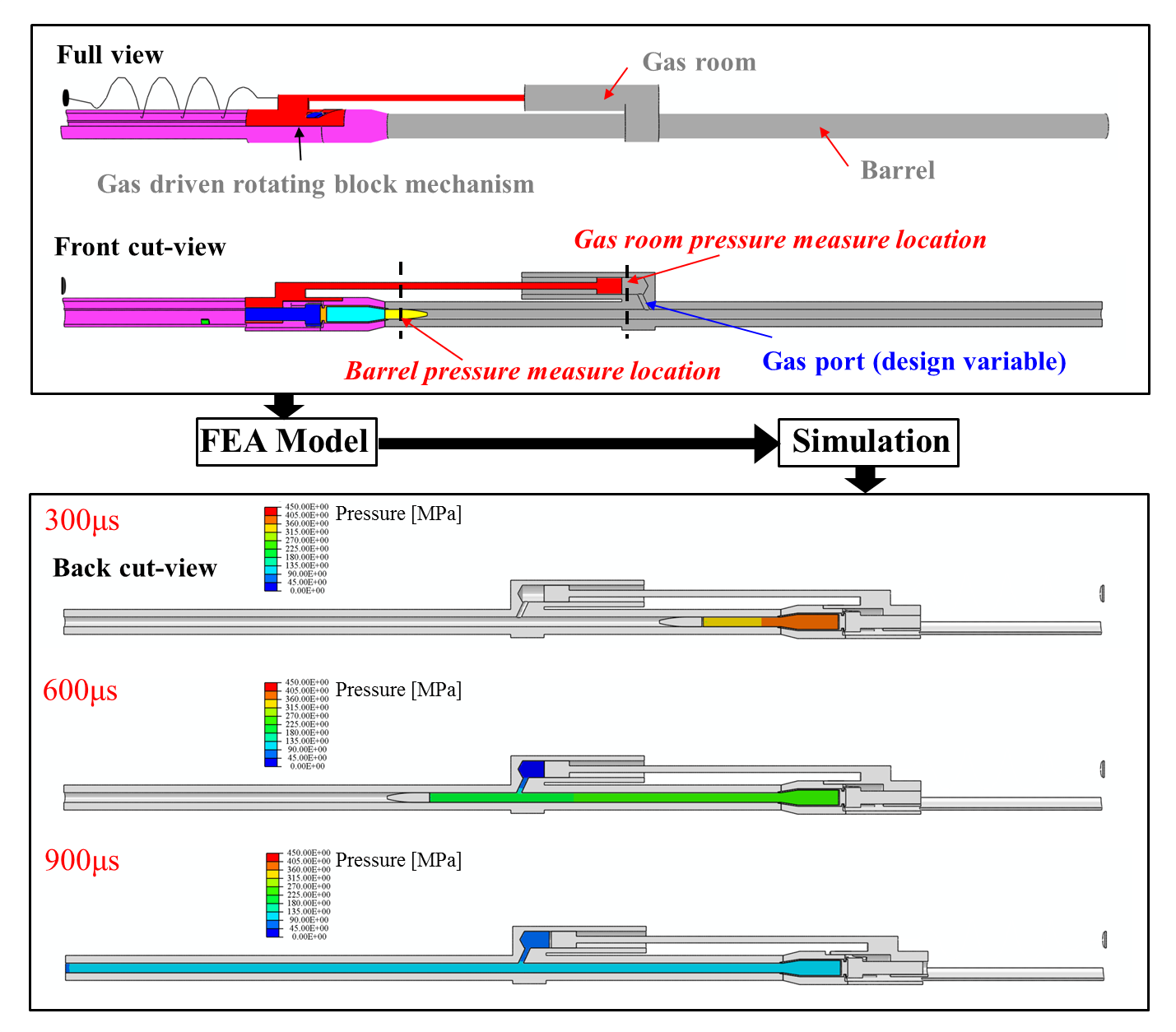
While the subject of ballistics has been investigated for several centuries, nowadays, the design of a ballistic component or device is still not an easy task, but usually a process of trial and error, or an iterative process of analysis, testing and tweaking. Concerning the design of a gun with a gas-operated piston system, it is challenging to accurately determine how a gas-operated piston system would affect the interior ballistic performance of the gun (e.g., muzzle velocity) due to gas loss and how large the chamber/gas-room pressure would be for safety purpose. To address this problem, a numerical approach based on the coupled Euler-Lagrange technique and a constitutive model for the combustion gas mixture of solid propellants is presented, where the constitutive model is developed by combining Vieille’s law for combustion and the equation of state for gas mixture. The model is validated by experiments for a double base propellant. The approach is then applied to study the effect of a gas-operated piston system on the interior ballistic performance of typical gun designs with different gas port radiuses. The interior ballistic parameters like the muzzle velocity and the highest barrel pressure are computed. Results show that these designs of gas ports influence the interior ballistic parameters very little. In addition, a larger gas port radius results in a larger gas room pressure, which indicates a faster operation of the gas-operated piston.
The paper can be found here:
=> Paper
I hope this paper is helpful to your research and other academic activities.